
Welcome!
I'm a Ph.D. candidate in Strategy and Business Economics at the Sauder School of Business at the University of British Columbia. My research lies at the intersection of International Trade, Political Economy, and Economic History.
My job market paper estimates the trade costs of geopolitical rivalry during the Cold War, using successful versus failed coups to identify the causal effect of geopolitical alignment on trade. This research is supported by the UK Foreign, Commonwealth and Development Office.
I have taught Environment, Society and Government (COMM 394) at Sauder, for which I received the UBC Killam Graduate Teaching Award.
My dissertation committee consists of Keith Head, Ayumu Ken Kikkawa, and Nathan Nunn.
You can find my CV here. You can reach me at nicolas.wesseler@sauder.ubc.ca.
I am on the 2026-2027 job market.
Research
Working Papers
Abstract
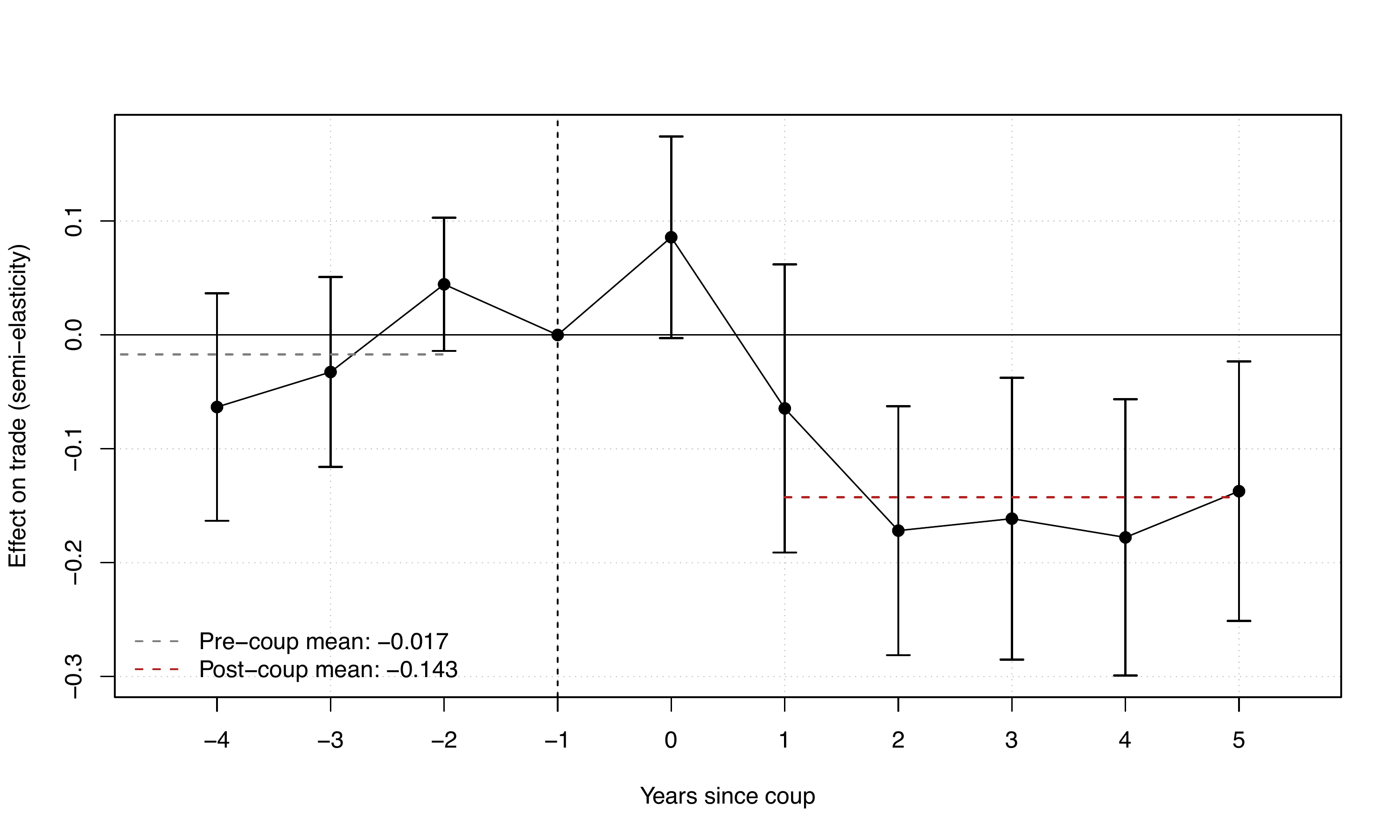
How costly is geopolitical fragmentation? We estimate the causal effect of political alignment on bilateral trade using the Cold War as a natural setting for geopolitical rivalry. We exploit coups d'état as abrupt political realignments, comparing successful coups both with countries experiencing no coup and with failed coup attempts. A one-unit increase in political distance reduces bilateral trade by approximately 20 percent in the medium run, equivalent to an ad valorem tariff of 3.7 percent on average and 12.2 percent for relationships involving the Cold War Superpowers. We show that foreign aid and sanctions respond to political realignment, but back-of-the-envelope calculations suggest that these formal policy channels account for only about 30 percent of the overall trade effect. A historical case study further shows that trade can respond in the absence of formal policy interventions. Embedding our estimates in a structural gravity model, we find substantial welfare costs concentrated among Non-Aligned countries. Applying the same framework to the contemporary U.S.–China rivalry, we find smaller economic costs of alignment but greater tension between countries' political and economic interests.
Abstract
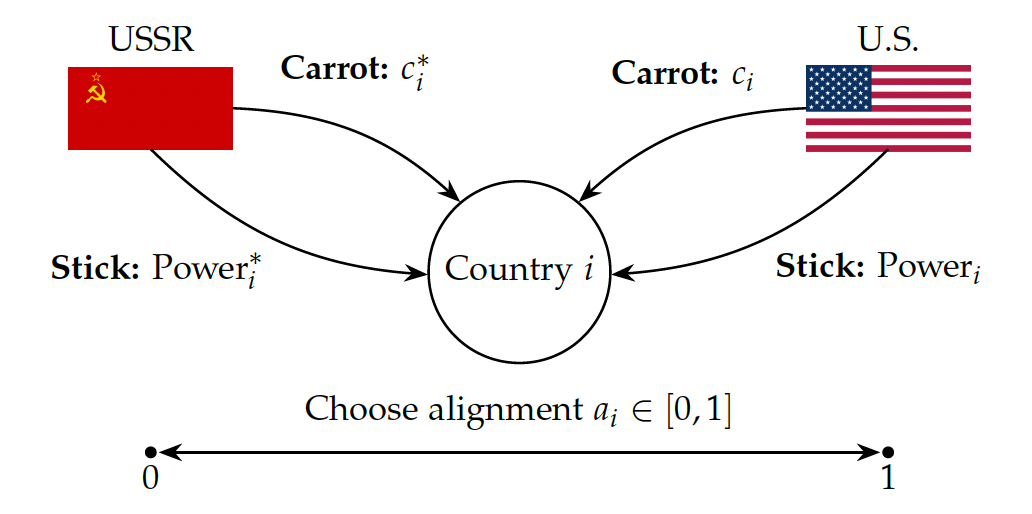
Hegemonic powers use economic tools to influence the geopolitical alignment of third countries. We develop a model in which two competing hegemons use direct payments (carrots) and economic threats (sticks) to influence third countries. Guided by the model, we measure carrots and sticks using historical data from the Cold War. We use our measures to empirically estimate the effects of carrots and sticks on geopolitical alignment. These tools create political alignment, but are expensive. We combine the model with the empirical estimates to compute the geopolitical return on foreign aid and evaluate the consequences of the USAID shutdown for the modern U.S.–China competition.
Publications
Abstract
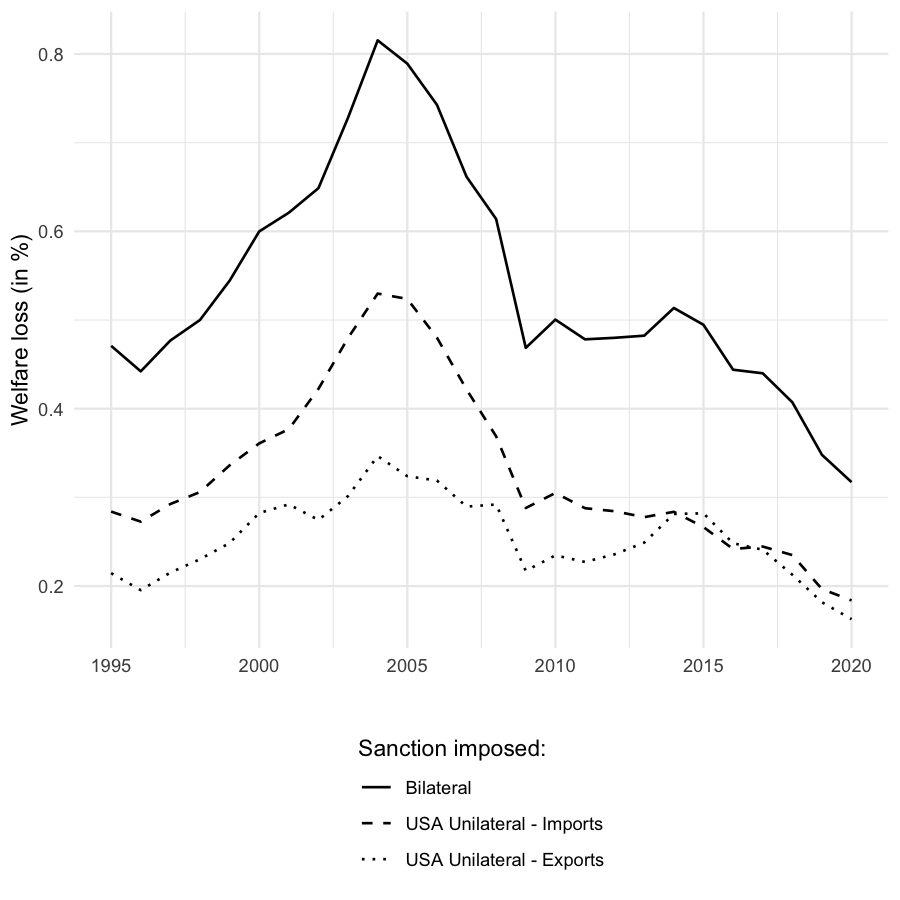
What determines the success or failure of economic sanctions? Theoretical research emphasizes the anticipated costs to both sender and receiver countries, but empirical findings remain inconclusive. This study introduces a novel measure of sanction costs by developing a bilateral reliance metric, which quantifies the welfare losses incurred when trade ties are severed. The metric is derived from an international trade model incorporating multiple sectors, sector-specific trade elasticities, and intermediate production networks. Results show that while the absolute magnitude of bilateral reliance depends on the complexity of the trade model, its changes over time remain stable. Empirically, I find little evidence that the economic costs to the receiver country influence sanction success. However, there is suggestive evidence that lower costs to the sender increase the likelihood of success, a finding that holds across different model specifications, samples, and databases.
Abstract
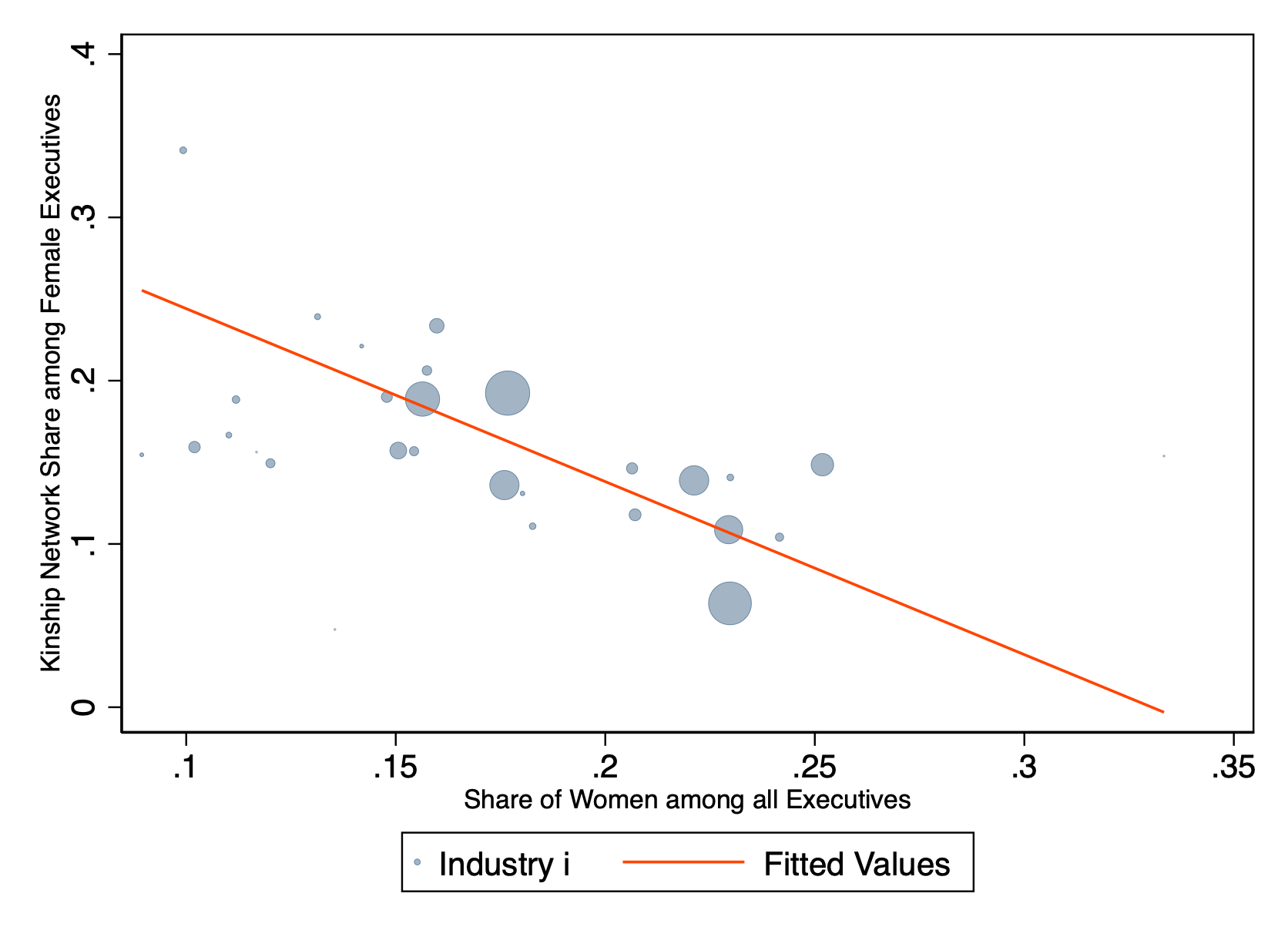
Leveraging data on firms operating in the Gulf Cooperation Council (GCC) countries and a novel measure of family ties among firm executives, we show the quantitative importance of kinship ties for female executives in settings and industries characterized by low female representation. Our findings suggest that kinship ties may bring women into executive networks, what we call "the glass web," that make up the proverbial glass ceiling which has traditionally kept women out of business leadership. We combine our executive-level data with administrative employer–employee matched data for Saudi Arabia to show that greater representation of women among firm executives, with or without a kinship tie, is associated with more gender-equal outcomes at the firm, including greater female employee share and smaller gender wage gaps.
Work in Progress
Abstract
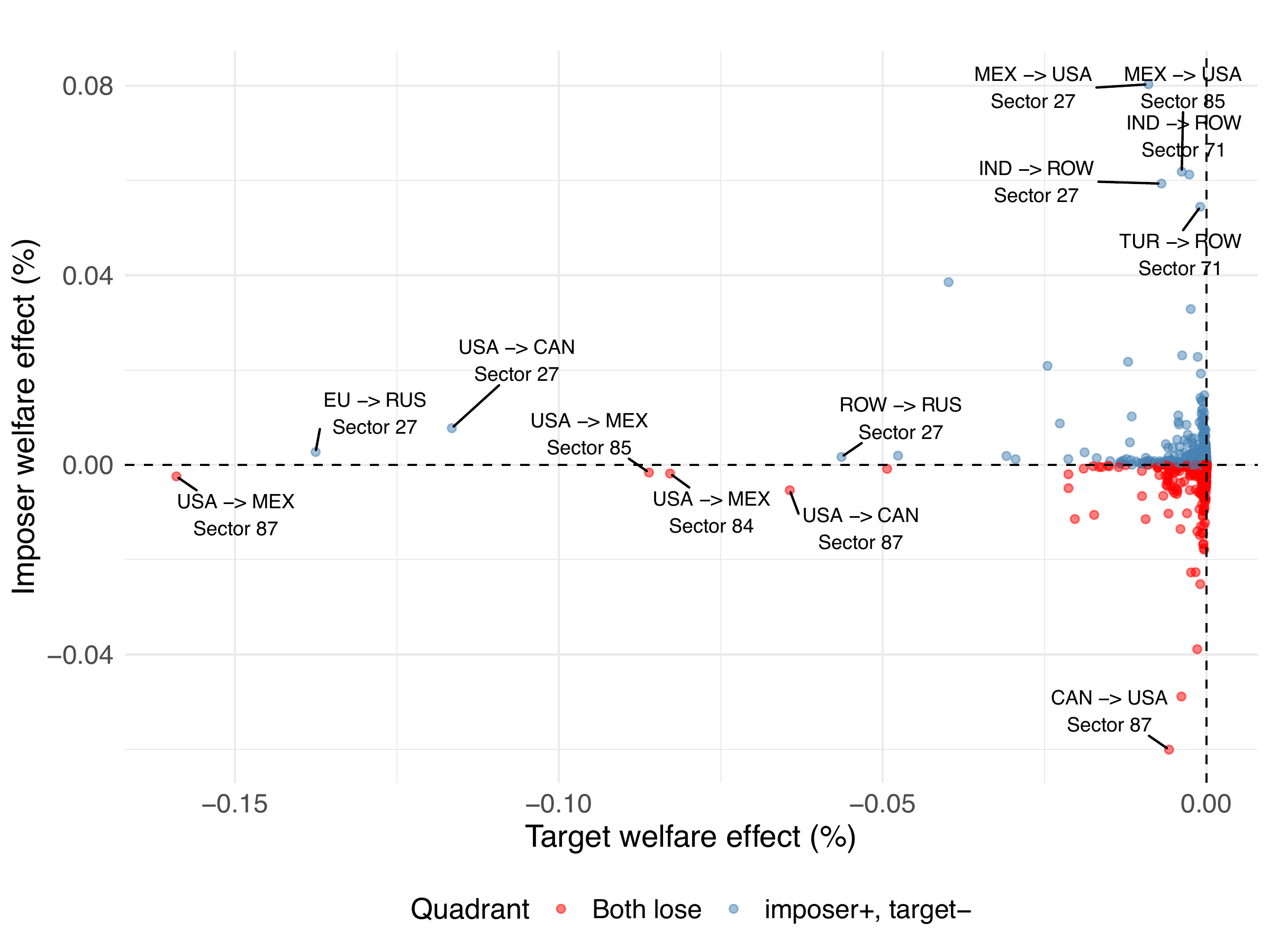
When China, Canada, Mexico, Turkey, and the EU designed their retaliatory tariffs, did they minimize their own economic costs, maximize costs to the United States, or target Republican-aligned industries for political reasons? We bring two innovations to this question: a structural trade model estimated on pre-tariff 2017 data to measure the welfare cost of targeting each industry to both the retaliator and the United States, and a trade-exposure-weighted measure of Republican political alignment based on the state-level composition of the U.S. exports each retaliator actually faces. China and the EU therefore receive different measures of the political alignment of the same U.S. industry because they source that industry from different states. Preliminary results show that both welfare cost measures are jointly significant predictors of targeting, consistent with rational economic objectives, but political alignment remains significant conditional on these costs, suggesting political targeting operates alongside economic self-interest rather than instead of it.
Abstract
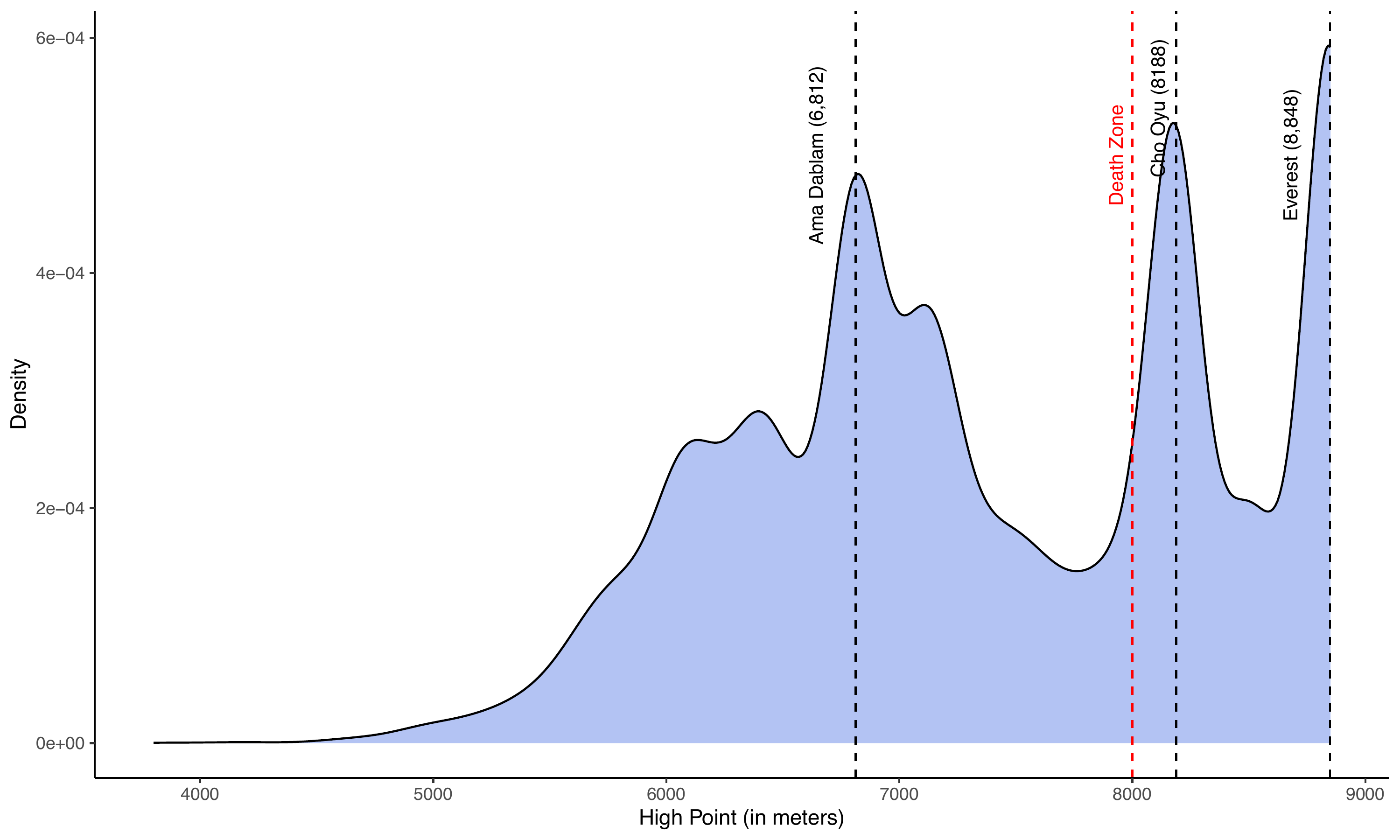
I study how geopolitical fragmentation affects the international diffusion of knowledge and technology. I use the Himalayan Database, which records the participation and performance of climbers in the Himalayas over more than a century, to examine how geopolitical barriers shape the formation of international social networks. Mountaineering provides a particularly rich setting because climbers from different countries repeatedly interact in expeditions, share techniques and equipment, and subsequently make observable choices about routes, peaks, and climbing practices. I exploit variation in climbers' exposure to international teammates and changes in the ability of climbers from different countries to interact, including periods of geopolitical separation and cooperation during the Cold War. I ask whether cross-border interactions lead to the adoption and diffusion of new technologies and practices, and whether geopolitical barriers to international exchange impede this process. The project contributes to a broader understanding of the economic consequences of geopolitical fragmentation by studying how restrictions on international interaction affect the transmission of knowledge through social networks.
Teaching
Instructor — University of British Columbia
-
COMM 394: Environment, Society and Government — Undergraduate, Summer 2025
Evaluation: 4.9 / 5.0 · UBC Killam Graduate Teaching Award 2025/2026
Teaching Assistant — University of British Columbia
- COMR 493: Strategic Management in Business — Undergraduate, Winter 2024, 2023
- COMR 491: Strategic Management — Undergraduate, Winter 2023
- COEC 498: Advanced International Business Management — Undergraduate, Winter 2023
- COMM 498: International Business Management — Undergraduate, Winter 2022
- ECON 455: International Trade — Undergraduate, Winter 2022, 2023